
Parents Behaving Very Badly
You Can't Change Them! You Can Only Change Your Own Behaviour

Write to me with any problem or dilemma at AskPhilippa@yahoo.com Subject to Terms and Conditions
Dear Philippa,
I have read your books and followed your column for many years, and it has been a source of wisdom and comfort throughout that time. I am hoping you might offer some guidance on a situation that feels increasingly difficult to navigate.
As with most things, my situation is complex, but I will try to be as brief and clear as I can.
My fiancé was previously married and has three children. He and his ex-wife separated almost seven years ago and have been divorced for nearly five. Everyone has accepted and adapted to the divorce, except his mother.
Despite the passage of time, she still believes they should remarry and insists that his ex-wife is longing for him, which is not true, she has a boyfriend and was the one who refused couples therapy at the time things weren’t working for them. Even when my fiancé explains this, his mother refuses to believe him.
His parents still display wedding photographs from his first marriage in their home, and it is impossible for him to have a normal conversation with them. His father always sides with his mother; they do everything together, even sharing a single mobile phone. His mother frequently says that the divorce was something her son “did to her” and, when she visits, she makes the sign of the cross over her son and grandchildren.
I know all of this is deeply painful for my partner, and it is clear that he chooses me. He has even suggested joint therapy with his parents, but they do not believe in therapy.
For me, it is a strange and uncomfortable position. I met my fiancé just over two years ago. I am introverted and have lived with social anxiety for many years, so I tend to stay out of his parents’ way. I am comfortable keeping to the background, but I do worry about whether this is the right approach.
For the children’s sake, we meet his parents occasionally in public places, and recently they came to our home for the first time with me present. My partner always checks with me beforehand, and I agree, and usually I’m the one encouraging it, but I try to make myself as invisible as possible.
When I first met his parents, I tried to speak with his father while his mother avoided me. When she noticed, she physically intervened to pull him away.
His mother frequently makes pointed comments about the children’s mother. On the surface they are harmless, even faintly comical, but they feel loaded. For example, she will tell the youngest child how beautiful he is “just like your mother”, while never saying the same to the older two, who resemble their father. The youngest child does not even particularly resemble his mother, which makes these comments feel oddly deliberate and unsettling.
Little is known about his mother’s background. She emigrated, and much of her past was kept secret. What we do know is that her own parents were divorced, something she concealed from her husband for years. I suspect there is unresolved trauma there, and I try to be respectful of that. However, in the past she was allowed to come to our home to help with the children, during which time my belongings would go missing or be moved, and even my toothbrush was turned upside down. Eventually we decided we no longer needed her help.
My dilemma is this: my fiancé and I will get married next year. His parents do not yet know. They see us occasionally, but when they make contact it is clear their focus is solely on the grandchildren, often ignoring their own son entirely. He finds this painful but accepts it as part of a lifelong pattern.
I am concerned that if his mother notices wedding rings, there will be a scene, particularly with the children present. Although the children like me, there has already been an incident where, even before she met me, she told the youngest child that I was a bad person. Thankfully, the child challenged her and later told his father.
I am also worried about the future. We hope to have a child together one day. I fear his parents may not accept that child as their grandchild, or alternatively may want access while still having no relationship with me. His mother has also said she only wants grandsons; which so far it is true, but what if I have a daughter? I don’t want our future child to feel rejected from family whatever might be the reason.
I know my partner will feel both sadness and relief one day — sadness for the relationship with his mother that never truly existed, and relief from a lifetime of control — but I worry the sadness will be the biggest part and if he should do more to try to connect even when his parents ignore him. I understand they are hurt, but why do you would want your child to be in an unhappy marriage? Why you don’t accept him? How is his divorce saying something about you? I know psychologically there is something here, but it is frustrating.
My question is: what should I do in my position? I am usually the one encouraging these family gatherings because I know they matter to the children. Yet I am met with being crossed as if I am something evil, and largely ignored. I make myself small and invisible. Should I be making more of an effort, or less.
Should my fiancé tell his parents about the wedding, or simply allow them to find out in their own time? Would telling them ease the situation, or only cause more hurt and conflict?
Should I be making more of an effort to engage with them, even when my attempts are met with rejection or strained responses?
To complicate things further, I’m an immigrant myself and my command of the local language remains limited. As a result, I often feel linguistically and emotionally exposed, and uncertain about how - or even whether - to communicate at all.
I would be very grateful for your perspective.
My Reply
This is a painful situation, and you describe it with clarity and generosity. You are doing a great deal to accommodate people who, at present, are not doing the emotional work required of them.
I want to name something plainly: your future in-laws are behaving badly. Not cruelly in an overt sense, but regressively. They are unable to tolerate change, ambiguity, or adult reality, and instead of adapting, they are sulking, clinging, and attempting to control the emotional environment around them. Your mother-in-law in particular appears stuck in a grievance that is now many years old, and she is recruiting others, including grandchildren, into maintaining it.
At the moment, you and your fiancé are unintentionally rewarding this behaviour.
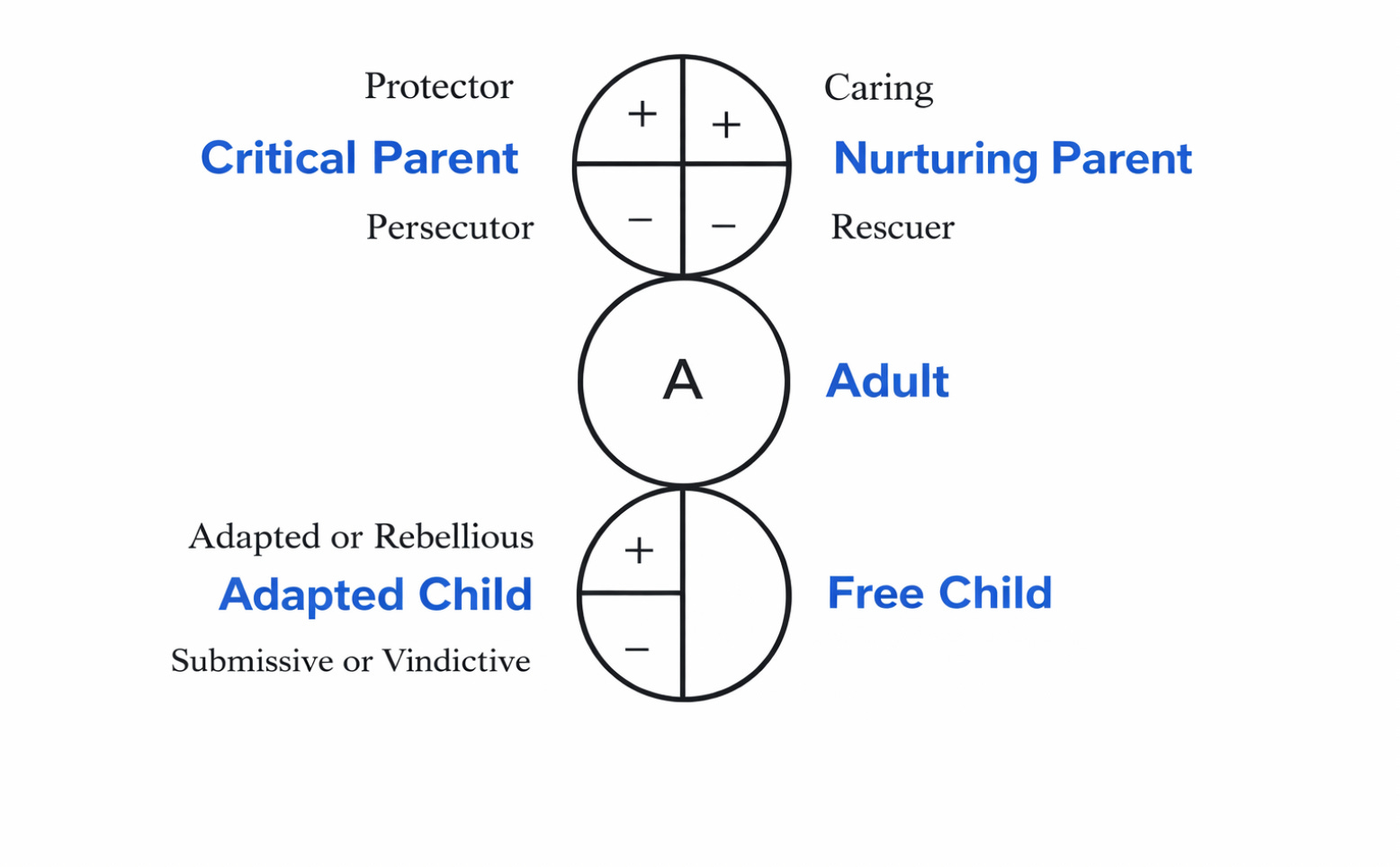
One useful way of understanding what is happening comes from transactional analysis, a psychological framework that looks at how people unconsciously take up roles in relationship. Broadly speaking, it describes three states we move between: parent, adult, and child. These are not about age or authority, but about emotional stance.
The adult state is grounded, realistic, and present-focused. It deals with facts, tolerates discomfort, and sets boundaries without drama. The child state is driven by fear, appeasement, rebellion, or longing for approval. The parent state can be nurturing, but when distorted it becomes controlling, moralising, or punitive. And controlling, moralising and punitive is where your in-laws are at. They are rigid, unable to accept loss and prone to sulking or manipulation when reality does not conform to their wishes. In response, you and your partner are slipping into the child role yourselves, appeasing, hiding information, making yourselves small, trying not to “upset” them, and carrying a sense of guilt for living your own lives.
This dynamic is a trap. As long as you respond from the child position, they cannot move into the adult one. The only way this system changes is if you and your fiancé step firmly into adult mode: calm, factual, boundaried, and non-defensive. Adult does not mean harsh. It means clear. To understand this more fully have a look at: Transactional Analysis Today: A New Introduction to Transactional Analysis is a psychology book by Ian Stewart (psychotherapist) and Vann Joines.
That brings me to the wedding. I do not think it is kind, to you, to your fiancé, or ultimately even to his parents, to keep your marriage plans secret. Secrecy does not protect people; it colludes with their denial and keeps them stuck. You are not responsible for managing your mother-in-law’s feelings about reality. Those feelings belong to her. What is your responsibility is to live honestly and without apology.
Telling them does not mean persuading them, justifying yourselves, or negotiating. It can be factual and contained: “We want you to know that we are getting married next year. We hope, in time, you can be at peace with this.” If there is upset, that upset already exists. You are not causing it; you are refusing to organise your lives around it. Stay strong on this, their hissy fit would be about them behaving badly, not you doing anything wrong.
The same principle applies to your presence. Making yourself invisible has not softened their behaviour; it has erased you. You do not need to try harder to be liked by people who are invested in not seeing you. Equally, you do not need to withdraw completely. Adult position here looks like polite engagement without self-erasure: you are present, civil, and calm, but you do not chase approval or tolerate disrespect.
Your concerns about future children are realistic. A family system that sorts grandchildren into “acceptable” and “unacceptable” categories is not a safe emotional environment. This is another reason boundaries matter now. Access to children cannot be separated from respect for their parents. That is not is not so much punitive as it is protective.
You ask whether your fiancé should do more to connect, even when he is ignored. I would gently suggest that what he is grieving is not a relationship he once had, but one he never truly received. There is sadness in accepting that, but also relief. Continually offering himself to people who cannot meet him only deepens the wound.
Finally, your immigration status, language limitations, and social anxiety make this situation harder still. You are operating without your usual social armour, and it makes your instinct to disappear understandable. But disappearing is not the same as being safe. You are allowed to take up space in your own life.
Kindness, in situations like this, does not mean endless accommodation. It means telling the truth without malice, holding steady when others wobble, and refusing to build your future around someone else’s unresolved past.
You and your fiancé do not need to become different people for his parents. You need to become adults in relation to them. If that happens, his parents may, or may not, follow. Either outcome is information, and both are survivable.
Such good advice rooted in evidence. I would only add how lucky your fiancé is to have a partner who is so reasonable and kind. Who is so understanding and genuinely invested in his family, children and parents. The parents seem narrow and selfish and their reasons for this are their problem, not yours. Celebrate your wedding, have your baby (never mind the gender) and enjoy every minute of the life ahead of you. You really deserve to be happy.
It occurs to me that in addition to the splendid advice given here you and your fiancé might want to go to therapy together so you have a third voice to ground you when you are learning to stick to your own boundaries. Especially as I imagine the in-laws will kick quite hard back to start with.
I also wonder whether the children can see their grandparents behaviour quite clearly - it sounds as if they do - in which case your boundary setting will help them to create healthy patterns too, rather than accepting dreadful people get to hold the power. I don’t know how old they are but perhaps its worth talking to them about how you do see the unfairness and how you don’t agree with it?